
Navigating Prague Public Transport
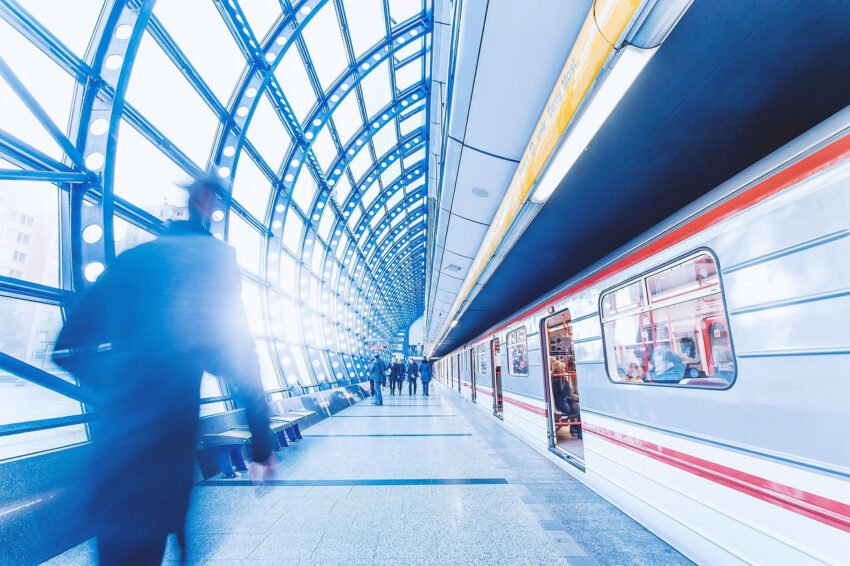
Prague city centre is entirely walkable, and I highly recommend walking as much as possible. Public transport in the Czech Republic—particularly in Prague—has repeatedly been voted one of the best in the world. It offers excellent connections, short waiting times, and is cheap and clean. It is also very safe; you don’t need to worry about taking the metro or tram at night. (Just beware of pickpockets on tram number 22 in the direction of Prague Castle.)
Trams and buses run non-stop (the night transport system is very effective as well), and the metro operates daily from 5 AM to midnight. For more details about transport connections, download the PID Lítačka app or IDOS (for searches throughout the country; it’s not necessary if you are only visiting Prague).
If you plan to use public transport, downloading PID Lítačka is a great idea. Not only will it provide all the necessary information about the best public transport connections, travel times, and ticket types, but the good news is that you can also buy tickets directly through the app. These tickets are cheaper than paper tickets purchased from ticket machines. All you need is a mobile phone.
The public transportation system also offers barrier-free travel, with low-floor vehicles (trams and buses) and barrier-free elevators in most metro stations.
Because the public transport system is so good and Prague is not a large city, don’t hesitate to book accommodation outside the historical city centre. You will get there in no time and can save a lot of money, as hotels and Airbnbs outside the centre are much cheaper.
Metro ( Subway )
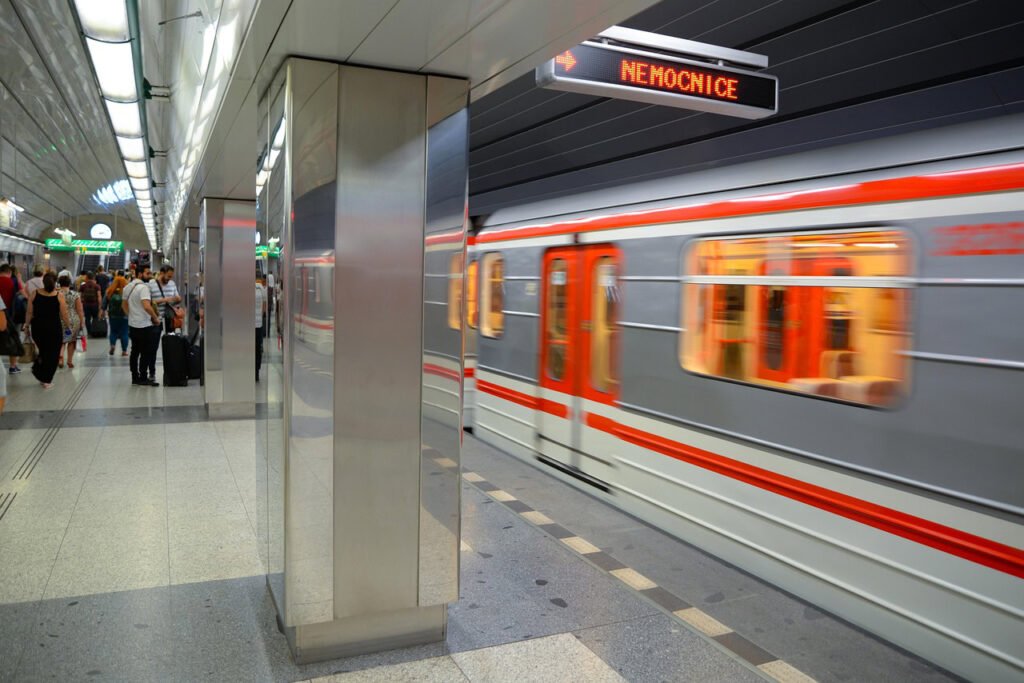
The Prague metro was first opened in 1974 and today carries approximately 1.6 million passengers per day. It is the fastest, most convenient, and simplest means of transport in Prague. It is highly reliable with no outages or delays.
The metro lines run under the Vltava River at four locations. Several metro stations are located directly in the city centre near important landmarks.
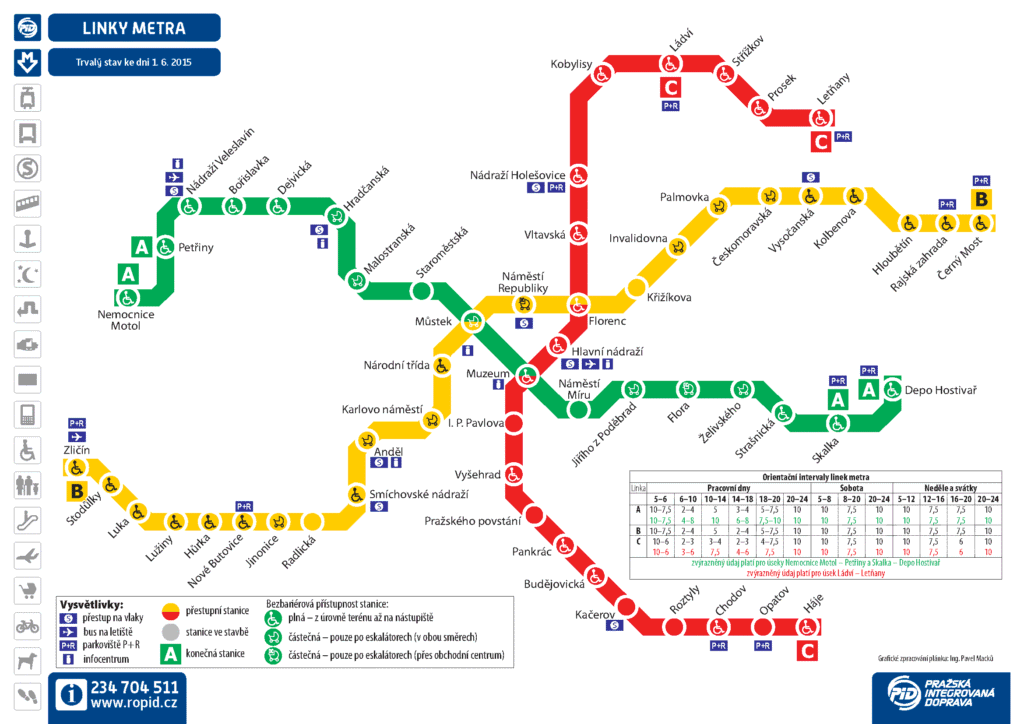
If you are not planning to walk everywhere, the metro is definitely worth trying. You don’t need to worry about getting lost — the system is relatively small and easy to navigate. It consists of only three main lines and 61 stations. The travel time between stations is usually one to two minutes.
Metro lines are each represented by their own colour:
- Line A (green line)
- Line B (yellow line)
- Line C (red line)
- Line D (blue line) is currently under construction
Transfer stations:
- Muzeum (Line C to Line A)
- Můstek (Line B to Line A)
- Florenc (Line B to Line C)
Operating hours: every day, all year round, from 5:00 AM to midnight.
During peak hours, trains run every 2–3 minutes. After 7 PM and on weekends, intervals extend to 4–9 minutes (depending on the line).
The Prague metro operates on an open ticket system — there are no turnstiles. Passengers must buy and validate a ticket before entering the metro platform. Paper tickets can be purchased from yellow machines located at the entrance of metro stations, or you can use the PID Lítačka app or an SMS ticket. Paper tickets must always be stamped. Ticket inspectors have the right to check ticket validity at any time within the metro area.
Trams
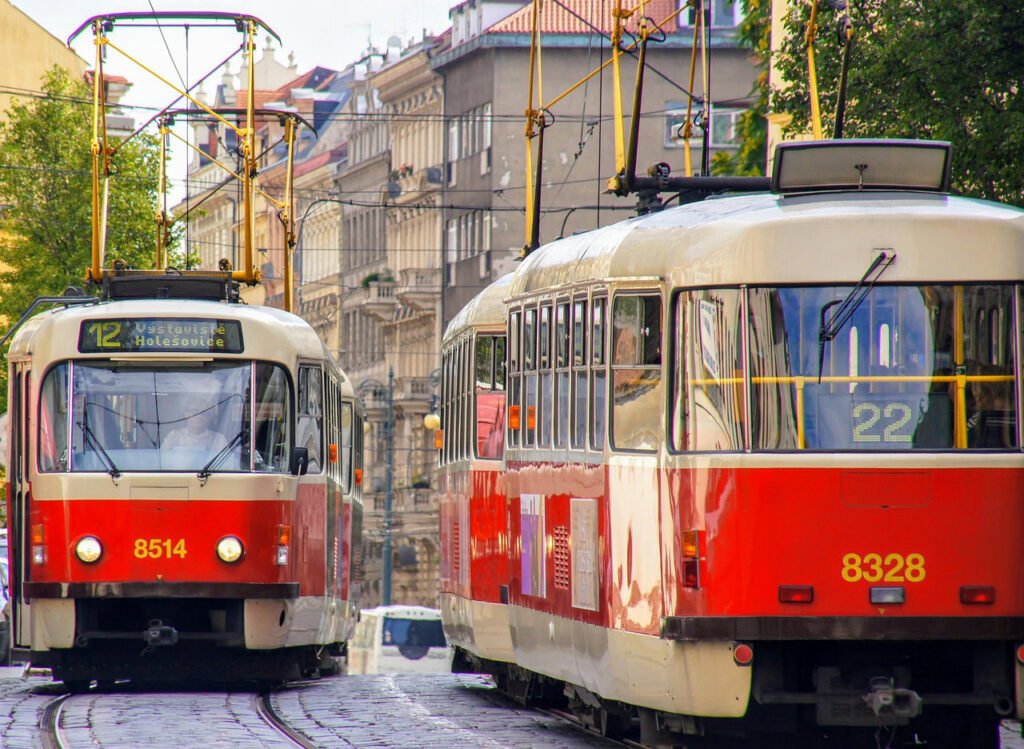
Tram lines are an important part of Prague’s history. The first tram operated in 1875 (at that time horse-drawn), and the first electric tram started running in 1891.
Today, Prague has an extensive tram network with approximately 51 lines (including 9 night tram lines) and around 600 tram stops. Travelling by tram is very popular among tourists, as you can see the city, many landmarks, and even cross the river from the windows.
Tram number 22 is particularly worth mentioning, as it goes to Prague Castle.
Buses
City buses are a popular means of transport in Prague, but they operate mainly in the outskirts rather than in the city centre. Prague has approximately 300 bus lines (including night buses) and around 2,300 bus stops.
For tourists, it is worth mentioning the Airport Express bus, which runs regularly from the airport to the main railway station. Another useful route is bus number 194, a small bus that travels through the Old Town towards Prague Castle.
There are also buses operated by various sightseeing agencies. If you plan to travel outside Prague and visit other interesting places in the Czech Republic, buses — together with trains — are a good option.
The Florenc Bus Terminal (Florenc Bus Stop terminal) is one of the largest bus stations. It is easily accessible on foot from the city centre.
Funicular ( Cable Car)
The funicular is one of Prague’s main attractions, and many tourists choose to ride to the top of Petřín Hill. From there, you can enjoy beautiful views of the city and Prague Castle.
In 2024, the funicular was closed for reconstruction and is scheduled to reopen in summer 2026. A single ticket costs 60 CZK and can be purchased directly at the funicular stations. If you have previously purchased a 24-hour or 72-hour public transport ticket, you can also use it for the funicular. Short term tickets are only valid for public transport.
Purchasing and Validating the Tickets
Public transport tickets can be purchased at any metro station (yellow ticket machines), on trams and buses, at newspaper stands, tobacco shops (Trafika), ticket offices, or tourist information centres in Prague. You can pay with coins (Czech crown – CZK, the local currency) or by debit card.
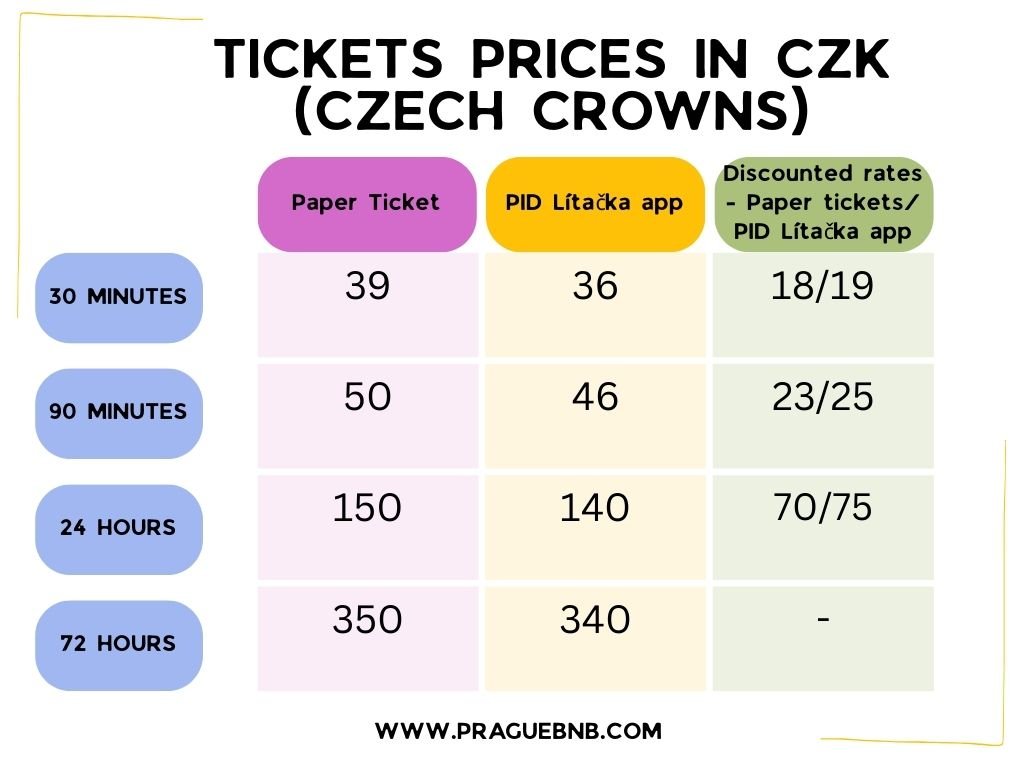
Tickets are valid for all means of transport (metro, bus, tram). The price is 39 CZK for 30 minutes (short-term tickets) and 50 CZK for longer journeys of up to 90 minutes. You may change metro lines or switch between different means of transport during your journey (e.g. tram and then metro).
Please note that if you travel with a big luggage ( larger than 25 × 45 × 70 cm (, you must purchase an extra ticket for 25 CZK. The same price applies when travelling with a dog. If passengers have a ticket with a time validity of one or more days, they may transport one piece of luggage or one animal free of charge.
If you plan to get around by more than just walking, it is worth buying a travel pass for 1 day (24-hour ticket for 150 CZK) or 3 days (72-hour ticket for 350 CZK).
Before your first trip, you must stamp your ticket in a validation machine; otherwise, the ticket is not valid and you risk paying a fine. A valid ticket is only one that has been stamped. If you change means of transport, stamp your ticket only once! A ticket stamped twice is considered invalid! Electronic tickets are automatically validated.
Electronic Tickets
Another option instead of purchasing a paper ticket is using electronic tickets. It is much easier than searching for a yellow ticket machine, and the ticket prices are lower. You can download the mobile application PID Lítačka (the official public transport app). It can be used both to buy tickets and to search for the best connection. Please note that if you use the app, you must activate your ticket one minute before boarding the vehicle.
An SMS ticket is another form of electronic ticket, but purchasing it requires a Czech SIM card. For more information, refer to https://pid.cz/en/tickets-and-fare/how-to-buy-ticket/
Who Can Travel for Free?
In Prague, the following passengers can travel for free:
- Children up to 15 years old
- People aged 65 and over
- One person accompanying a child under 3 years of age (only one accompanying person)
Discounts
- Students aged 18–26 receive discounted fares on regional tickets. In Prague, the discount applies only to season tickets (an International Student Identity Card – ISIC – is required).
- People aged 60–65 are entitled to discounted fares.
- If you purchase tickets via the mobile app PID Lítačka, there is a discount on each ticket.
- If you buy a 1-day or multi-day ticket, luggage and a dog are transported free of charge.
- If you buy a 1-day or multi-day ticket, the funicular to Petřín (Petřín cable car) is free of charge; otherwise, it costs 60 CZK.
Please remember that to claim a discounted or free ride, you must always carry proof of age and present it upon request. A travel document such as an ID card (for EU citizens only) or a passport is sufficient. It must clearly state your name, date of birth, and include a photo.
If you wish to apply for a student discount, you must carry your student card (ISIC).
Ticket Inspectors and Fines
Tickets are frequently checked by inspectors who board trams, buses, and the metro. Fines can be paid in cash, by debit card, or via bank transfer.
- Travelling without a ticket (or with an invalid one) results in a fine of 1,500 CZK. If paid on the spot, the fine is reduced to 1,200 CZK.
- If you do not have a luggage or dog ticket when required, the fine is 400 CZK, reduced to 200 CZK if paid on the spot.
- If you choose to pay by bank transfer, you must do so within 15 days; otherwise, the amount increases.
Please note that paper tickets that are not stamped or stamped more than once are considered invalid (neplatný), and you will have to pay a fine.
How to Get to the Main Prague Hotspots by Public Transport
The entire city centre of Prague is walkable, and so are all the main monuments. However, if you need or want to try public transport, here is a brief guide on how to reach the most popular tourist destinations. I always recommend using the closest metro or tram station.
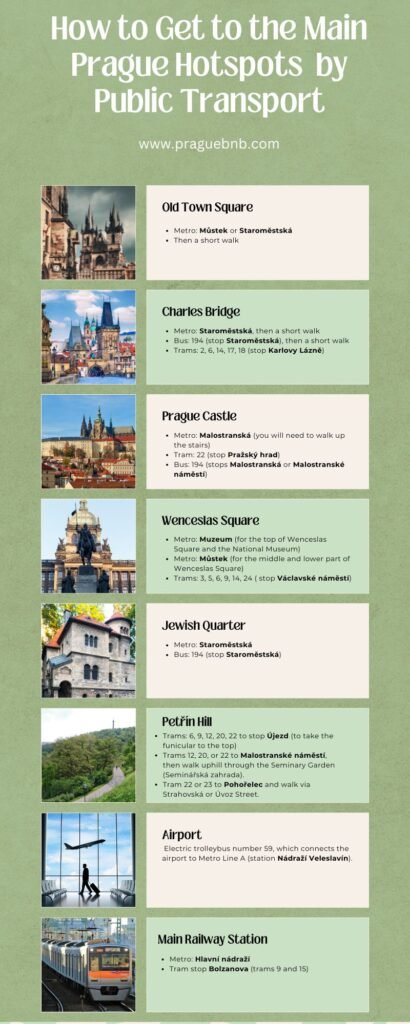
Old Town Square
- Metro: Můstek or Staroměstská
- Then a short walk
Charles Bridge
- Metro: Staroměstská, then a short walk
- Bus: 194 (stop Staroměstská), then a short walk
- Trams: 2, 6, 14, 17, 18 (stop Karlovy Lázně)
Prague Castle
- Metro: Malostranská (you will need to walk up the stairs)
- Tram: 22 (stop Pražský hrad)
- Bus: 194 (stops Malostranská or Malostranské náměstí)
Wenceslas Square
- Metro: Muzeum (for the top of Wenceslas Square and the National Museum)
- Metro: Můstek (for the middle and lower part of Wenceslas Square)
- Trams: 3, 5, 6, 9, 14, 24
Jewish Quarter
- Metro: Staroměstská
- Bus: 194 (stop Staroměstská)
Petřín Hill
- Funicular from Újezd
- Trams: 6, 9, 12, 20, 22 to Újezd (to take the funicular to the top)
- Alternatively: Trams 12, 20, or 22 to Malostranské náměstí, then walk uphill through the Seminary Garden (Seminářská zahrada).
- Via Pohořelec (gradual incline): Take tram 22 or 23 to Pohořelec and walk via Strahovská or Úvoz Street.
Václav Havel Airport Prague
- High-capacity electric trolleybus number 59, which connects the airport to Metro Line A (station Nádraží Veleslavín).
Praha hlavní nádraží (Main Train Station – Hlavní nádraží)
- Metro: Hlavní nádraží
- Tram stop Bolzanova (trams 9 and 15)

Celebrate Easter 2026 in Prague: Markets and Traditions
Easter in Prague and the Czech Republic Easter is an important holiday in the Czech…
History of Prague
Prague has grown for more than a thousand years, starting as small settlements on the…
Basic information for travelers
Here are some useful basics for travelers heading to Prague : Language: Czech is the…
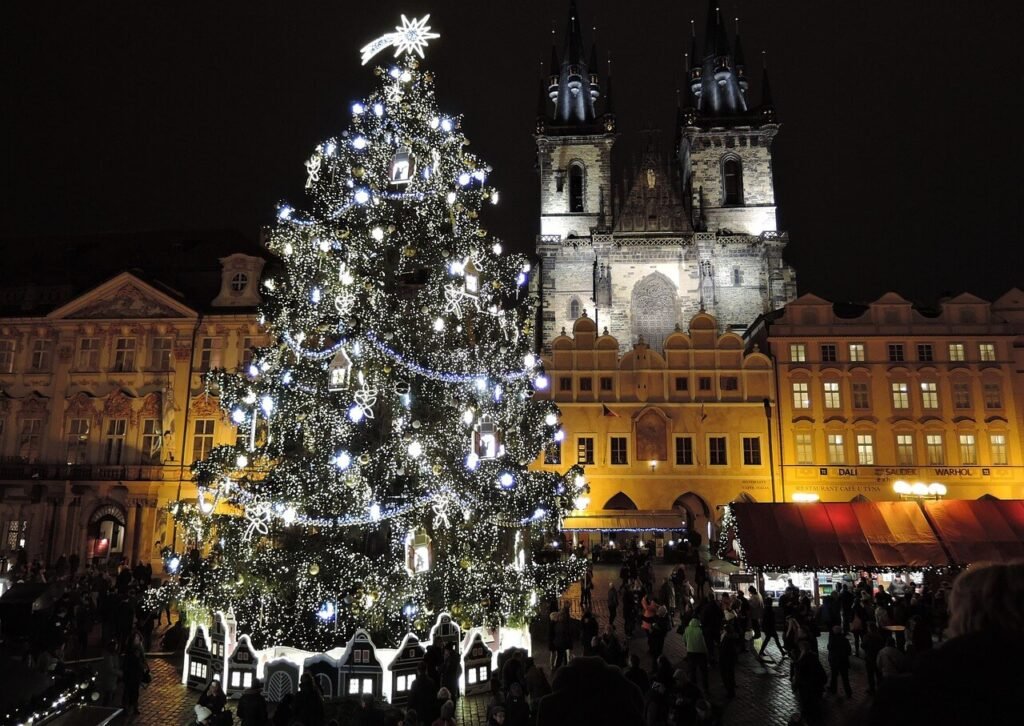
Best Christmas Markets and Events in Prague 2025
Christmas in Prague: A Magical Time of Year The Advent and Christmas season is truly…

Prague Landmarks: The Top Attractions for First-Time Visitors
Exploring the city of Prague, the enchanting capital of the Czech Republic, is one of…